
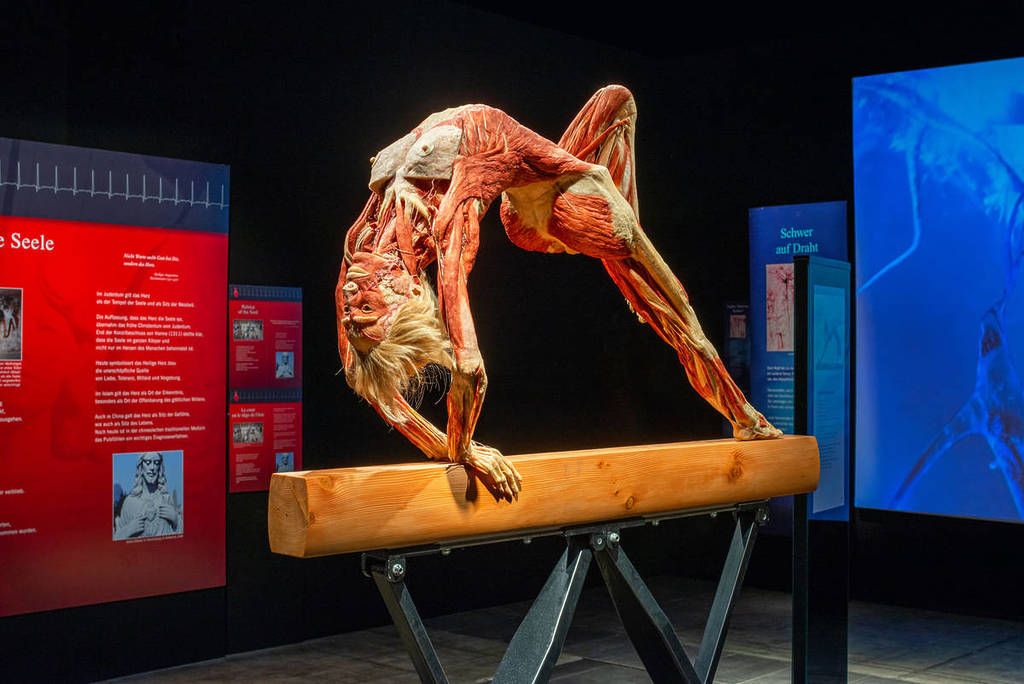
This blog entry was originally an academic essay I wrote for an Art History module on the Body and Visual art. It discusses the above thesis using two case studies which have hugely inspired my own work.
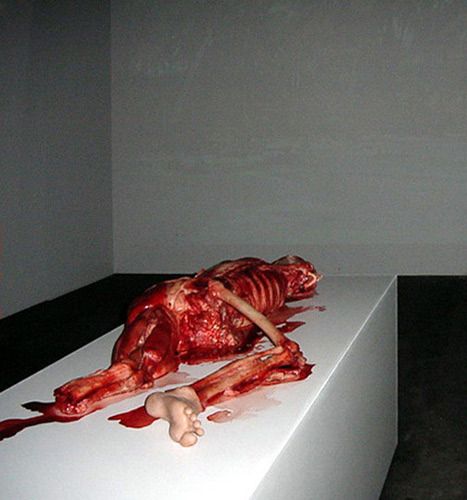
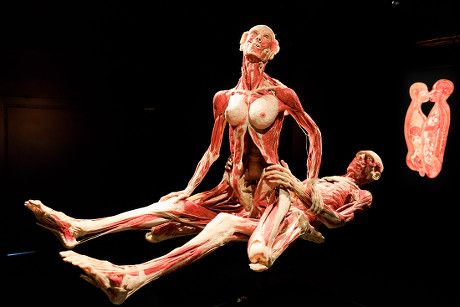
The “medical body” is often presented as neutral and factual, something that can be opened and understood through science. However, feminist scholarship and political theory show that medical ways of seeing are never fully objective. Anatomical knowledge is shaped by power, including who gets to look, whose bodies are used, and what counts as “normal” or valuable. When the body’s interior is made visible in public culture, it does more than educate, it also reflects wider politics of control, objectification, and authority.
This essay explores feminist and political critiques of the medical body through Gunther von Hagens’ Body Worlds (1995) and John Isaacs’ A Necessary Change of Heart (1999). Although very different, both use the opened body to question the ethics of looking. Body Worlds turns human remains into public spectacle framed as education, while Isaacs presents a dismembered figure that makes anatomical visibility feel violent rather than empowering. Together, they show that “transparency” is never neutral, it exposes who gets access, what power looking holds, and whose bodies are made displayable.
A key way of understanding the politics of medical imagery is Michel Foucault’s idea of the “medical gaze.” In The Birth of the Clinic (1963), Foucault argues that modern medicine often treats truth as something located inside the body and revealed through expert observation. The body becomes a kind of object that can be read, classified, and interpreted by professional authority.1 This matters when bodies are displayed publicly, because it shapes the viewer’s role. The audience becomes a kind of medical observer, positioned as someone entitled to look and “know” through sight.
Feminist critique adds that knowledge is not produced from nowhere. Donna Haraway’s concept of “situated knowledges” argues that objectivity is always shaped by perspective and power.2 Even when something is presented as “pure science,” it still reflects choices about what counts as normal, what gets centred, and what gets made visible. In anatomy-based works, those choices show up in the way bodies are staged, explained, and consumed by the viewer. The opened body is therefore political not only because of what it shows, but because of what it teaches viewers to accept as normal, especially the idea that bodies exist to be looked at.
Gunther von Hagens’ Body Worlds is one of the best-known public anatomy exhibitions in recent decades. It uses plastination, a process that preserves real human remains by replacing bodily fluids with polymers, creating dry and long-lasting bodies and organs.3 The exhibition is usually framed as educational. Visitors are invited to learn about bodily systems, disease, and lifestyle effects through direct viewing. Yet academic criticism has repeatedly pointed out that Body Worlds is not simply medical learning. It is also performance, entertainment, and commercial display, and those features shape the politics of the medical body.4
1 Michel Foucault, The Birth of the Clinic: An Archaeology of Medical Perception (London: Routledge, 1973), 112.
2 Donna Haraway, “Situated Knowledges: The Science Question in Feminism and the Privilege of Partial Perspective,” Feminist Studies 14, no. 3 (1988), 184.
3 Lawrence Burns, “Gunther von Hagens’ BODY WORLDS: Selling Beautiful Education,” The American Journal of Bioethics 7, no. 4 (2007), 12.
4 Lawrence Burns, “Gunther von Hagens’ BODY WORLDS: Selling Beautiful Education,” The American Journal of Bioethics 7, no. 4 (2007), 13.
A major feature of Body Worlds is that the corpses are not displayed in a detached, clinical way. Instead, many are posed upright and arranged as if they are doing something. Running, jumping, playing sport, or gesturing mid-action. This matters because it changes the body from a “specimen” into a public attraction. Lawrence Burns argues that the show markets “beautiful education,” meaning that learning is delivered through spectacle and aesthetic appeal.5 The bodies can begin to feel like sculptures rather than dead people, which blurs the line between education and consumption. Posing also makes the corpse feel almost “alive.” The suggestion of movement can draw attention away from the fact that these are human remains. This is where the exhibition becomes politically uncomfortable. If the body is treated as a dramatic display object, personhood can disappear. Instead of thinking about the dead as individuals with histories, viewers are encouraged to see “the human body” as universal material for learning.
Linda Schulte-Sasse’s critique is useful here because it frames Body Worlds as part of a wider culture of spectacle and consumer experience.6 In this reading, the exhibition becomes something that audiences buy into, a branded encounter with death and anatomy, packaged through claims of consent and education. That does not mean visitors learn nothing, but it does mean the learning happens through a system that turns bodies into products. This is a political issue because it normalises the idea that bodies can be used and displayed, as long as the right justification is attached.
5 Lawrence Burns, “Gunther von Hagens’ BODY WORLDS: Selling Beautiful Education,” The American Journal of Bioethics 7, no. 4 (2007), 16.
6 Linda Schulte-Sasse, “Advise and Consent: On the Americanization of Body Worlds,” BioSocieties 1, no. 4 (2006), 380.
Stephen Bates describes cadaver exhibitions as cultural “texts” that invite interpretation, meaning they do not simply show bodies but also tell audiences what bodies mean.7 Body Worlds tells a story where anatomical truth is accessible through looking, and where the viewer becomes a legitimate observer. That is essentially the medical gaze moved into public space. The authority that normally belongs to medicine becomes something the visitor temporarily performs.
One of the strongest political effects of Body Worlds is how it frames health. The exhibition often shows “healthy” organs next to “damaged” ones, for example lungs harmed by smoking or arteries narrowed by plaque. This encourages visitors to read the inside of the body as evidence of lifestyle choices. Instead of seeing illness as complex and socially shaped, the exhibition often pushes a simple story; good habits create “good bodies”, bad habits create “bad bodies”. Elizabeth Stephens argues that public anatomical exhibitions contribute to “inventing the healthy body” as a cultural ideal.8 The exhibition teaches not only anatomy, but a way of thinking about health that fits with popular medical discourses of risk and self-management. The body becomes a personal project, something that must be constantly monitored, improved, and disciplined. Stephens links this to neoliberal health culture, where responsibility is pushed onto individuals rather than understood structurally.9
7 Stephen Bates, “Bodies Impolitic? Reading Cadavers,” International Journal of Communication 4 (2010), 198.
8 Elizabeth Stephens, “Inventing the Healthy Body: The Use of Popular Medical Discourses in Public Anatomical Exhibitions,” in The Body Divided: Human Beings and Human ‘Material’ in Modern Medical History, ed. Sarah Ferber and Sally Wilde (Farnham: Ashgate, 2011), 223
9 Elizabeth Stephens, “Inventing the Healthy Body: The Use of Popular Medical Discourses in Public Anatomical Exhibitions,” in The Body Divided: Human Beings and Human ‘Material’ in Modern Medical History, ed. Sarah Ferber and Sally Wilde (Farnham: Ashgate, 2011), 230.
The political problem is that social causes of illness e.g. poverty, unsafe work, housing inequality, racism in healthcare etc. can disappear behind the idea that bodies simply reflect personal choice. This is where Body Worlds becomes more than education. It takes viewers into a moralised reading of the medical body. The inside of the body is presented like proof, the “truth” of someone’s lifestyle and discipline becomes visible in flesh. The exhibition therefore does not just teach the body, it teaches a particular kind of citizen, one who is expected to manage risk and blame themselves when they fail. Stephens notes that public anatomy exhibitions can become especially loaded around reproductive visibility, where the displayed interior connects to cultural debates about motherhood, morality, and vulnerability.10 Even in an educational context, the female body may be read through social expectations more than the male body is. That means anatomical display can reproduce gendered judgement while claiming neutrality.
These exhibitions normalise the availability of bodies to the gaze. Stone and Morton argue that the female dead body is often framed through unequal traditions of objectification and spectacle.11 While Body Worlds includes bodies of different genders, the format still invites a consuming look. The viewer is positioned as someone who can inspect bodies up close, often without the emotional weight normally attached to human remains. Brown and Moore’s research suggests that audiences interpret Body Worlds through a range of responses, including education, reflection on mortality and voyeurism.12
10 Elizabeth Stephens, “Inventing the Healthy Body: The Use of Popular Medical Discourses in Public Anatomical Exhibitions,” in The Body Divided: Human Beings and Human ‘Material’ in Modern Medical History, ed. Sarah Ferber and Sally Wilde (Farnham: Ashgate, 2011), 233.
11 Philip R. Stone and Catriona Morton, “Portrayal of the Female Dead in Dark Tourism,” Annals of Tourism Research 97 (2022), 2.
12 C. Mackenzie Brown and Charleen M. Moore, “Experiencing Body Worlds: Voyeurism, Education, or Enlightenment?,” Journal of Medical Humanities 28, no. 4 (2007), 237.
This matters because it shows the exhibition is not experienced as purely one thing. However, feminist and political critique focuses on structure: Body Worlds makes the body available for public consumption, aestheticises the corpse, and often channels anatomy into moral discipline.13 John Isaacs’ sculpture A Necessary Change of Heart offers a very different use of the medical body. Instead of presenting anatomy as clean and instructive, Isaacs shows a body that is dismembered, bleeding, and hard to look at for some. The work depicts a corpse-like figure with severed limbs and an opened torso. Rather than encouraging curiosity, it creates discomfort, forcing the viewer to confront the violence involved in anatomical exposure.
Silvia Di Marco describes the sculpture as using materials such as microcrystalline wax to create intense realism and fragility.14 The body looks vulnerable, damaged, and disturbingly present. Unlike Body Worlds, which turns shock into learning, Isaacs keeps shock in place. The viewer is not offered the relief of “education.” The work produces a feeling that something is wrong with looking, and that feeling becomes the critique. Wax bodies often sit between art and science, they have a long established relationship with anatomical education. They look real, but they are made, staged, and theatrical. Di Marco argues that contemporary anatomical artworks using realism and flesh-like material can expose the instability of “truth” by showing that visibility is always constructed.15 This fits Isaacs well. The sculpture looks real enough to disturb, but its material also signals that this body is a representation, not a specimen.
13 Philip R. Stone and Catriona Morton, “Portrayal of the Female Dead in Dark Tourism,” Annals of Tourism Research 97 (2022), 5.
14 Silvia Di Marco, “Anatomy and Transparency in Contemporary Art,” CITAR Journal 7, no. 2 (2015), 41.
15 Silvia Di Marco, “Anatomy and Transparency in Contemporary Art,” CITAR Journal 7, no. 2 (2015), 40.
That tension is politically useful. The viewer is pulled between fascination and disgust. Realism makes the body feel close, but disgust makes the viewer want to look away. Isaacs interrupts the medical gaze by making looking feel ethically uneasy rather than empowering.
This connects back to Foucault’s medical gaze, where knowledge is produced by reorganising bodies into readable parts.16 Isaacs forces attention to what that “reorganisation” implies. In this sculpture, anatomy is not a neutral mapping of systems. It looks like harm. The body becomes readable because it has been destroyed. That is the political accusation embedded in the work.
Both Body Worlds and A Necessary Change of Heart use the opened body to trigger strong reactions, but they do it in opposite ways. Body Worlds often presents anatomy as accessible knowledge. The viewer is trained into medical looking and encouraged to leave with messages about health and self-improvement. Burns’ idea of “beautiful education” highlights how spectacle becomes a selling point rather than a problem, shaping the way learning is experienced.17 In feminist terms, the exhibition also raises concerns about objectification and unequal cultural meanings attached to bodily exposure, especially around reproduction.
Isaacs’ sculpture produces critique through discomfort. It does not teach anatomy or celebrate visibility. It makes anatomy feel violent and ethically wrong. Instead of encouraging confident observation, it destabilises the viewer. The medical body becomes a political image of disposability, harm, and the limits of transparency. Isaacs’ work critiques the authority of the medical gaze by refusing the fantasy that visibility equals truth.
16 Michel Foucault, The Birth of the Clinic: An Archaeology of Medical Perception (London: Routledge, 1973), 163.
17 Lawrence Burns, “Gunther von Hagens’ BODY WORLDS: Selling Beautiful Education,” The American Journal of Bioethics 7, no. 4 (2007), 14.
The medical body is never just biological, it is cultural and political, shaping ideas of authority, health, and value. Body Worlds presents anatomy as education, but also turns human remains into spectacle and promotes moralised “personal responsibility” for health. Critics argue it encourages people to judge bodies through neoliberal ideas of discipline and risk management, while feminist critiques highlight how it normalises access to bodies and makes exposure uneven. John Isaacs’ A Necessary Change of Heart challenges the same system from the opposite angle. Through dismemberment and wax realism, the sculpture makes anatomical visibility feel brutal rather than enlightening. It refuses a neat educational function and instead frames the opened body as evidence of vulnerability and violence. The result is a critique of the medical gaze itself. The viewer cannot look comfortably or claim mastery through sight.
Bibliography
Burns, Lawrence. “Gunther von Hagens’ BODY WORLDS: Selling Beautiful Education.” The American Journal of Bioethics 7, no. 4 (April 2, 2007): 12–23. https://doi.org/10.1080/15265160701220659.
Di Marco, Silvia. “Bodies of Knowledge – Anatomy and Transparency in Contemporary Art.” Journal of Science and Technology of the Arts 7, no. 2 (December 31, 2015): 33. https://doi.org/10.7559/citarj.v7i2.157.
Donna Jeanne Haraway. Situated Knowledges. Routledge, 1988.
Foucault, Michel. Birth of the Clinic. Presses Universitaires de France, 1963.
Moore, Charleen M., and C. Mackenzie Brown. “Experiencing Body Worlds: Voyeurism, Education, or Enlightenment?” Journal of Medical Humanities 28, no. 4 (September 18, 2007): 231–54. https://doi.org/10.1007/s10912-007-9042-0.
Schulte-Sasse, Linda. “Advise and Consent: On the Americanization of Body Worlds.” BioSocieties 1, no. 4 (December 2006): 369–84. https://doi.org/10.1017/s1745855206004017.
Stephens, Elizabeth. “The Use of Popular Medical Discourses in Public Anatomical Exhibitions.” In The Body Divided: Human Beings and Human “Material” in Modern Medical History, 223–38. Routledge, 2011.
Stone, Philip R., and Catriona Morton. “Portrayal of the Female Dead in Dark Tourism.” Annals of Tourism Research 97, no. 97 (November 2022): 103506. https://doi.org/10.1016/j.annals.2022.103506.